Posts

SpeechSuper API Now Supports Mandarin Chinese Mispronunciation Detection
Image
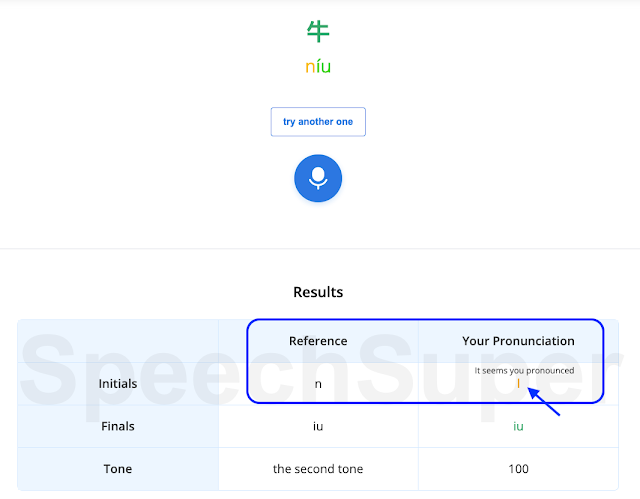
SpeechSuper has long supported the assessment of Mandarin Chinese character pronunciation by scores. However, scores might be insufficient to give concrete instructions to users.  We're excited to announce that SpeechSuper recently launched the feature - the Mandarin Chinese mispronunciation detection. It spots users' mispronunciations of Chinese characters and returns if they mispronounced an A sound for a B sound, making feedback more specific. Here are two examples.  Example 1: A user was expected to read aloud "níu", but she said, "líu", confusing the initial "n" and "l" in pronunciation. SpeechSuper API found the error she mispronounced 'n' for 'l' with a confidence score of 100. Example 2: A user was expected to read aloud "shēng", but she said, "shēn", confusing the final "-eng" and "-en" in pronunciation. Click here to try it out. SpeechSuper API found the error she misprono...

What is Speech Assessment and Why it Matters

Image
by Qiusi, Product Manager of SpeechSuper  What is Speech Assessment Speech assessment is the process of giving algorithm-based corrective feedback for speaking activities in language learning. It's also sometimes called pronunciation assessment. Speech Assessment 101 Speech assessment is largely based on the "Goodness of Pronunciation" (GoP) algorithm developed over 20 years. While automatic speech recognition (ASR) aims to decode the best possible option of acoustic model and language model combined derived from data in a specified language, GoP only cares about the acoustic model with the language model pre-defined, hence producing an acoustic likeliness score measuring “how similar a speech sounds like compared to native speakers of a particular language”, which, in short, is pronunciation. Simply put, for speech assessment, the input is speech audio + reference text, and the output is a score of pronunciation.   Evolution of Speech Assessment Over the past decades, th...